PRODUCTS & PLATFORM

Five modules, one path
from knowledge to action

MiliAgent decides what to do. MiliFlow lands those actions in approvals and tickets. MiliRAG supplies evidence you can trace. MiliGate governs every model call. MiliEval answers whether the last change actually helped. Each module drops into the stack you already run, or the five together form a complete agent foundation. Every capability is exposed through APIs and plugin extension points, so nothing has to be replaced first.

Platform overview

Each module clears one blocker; together they make a path

Plenty of teams buy model capability and still can't put it to work, and the blockers sit at different points: nobody knows what to hand it, the output can't reach the process, the answers have no source, the calls go ungoverned, and after a change nobody can say whether it improved. These five modules map onto those five blockers.

How to choose

Which piece first?

Teams that already have a knowledge base and applications usually start with MiliGate and MiliEval, to get cost and quality under control first. Teams starting from scratch tend to pair MiliRAG with MiliAgent, prove one real use case, then expand outward.

Book an architecture review

MILIAGENT

Agent platform: turn one request into steps that execute

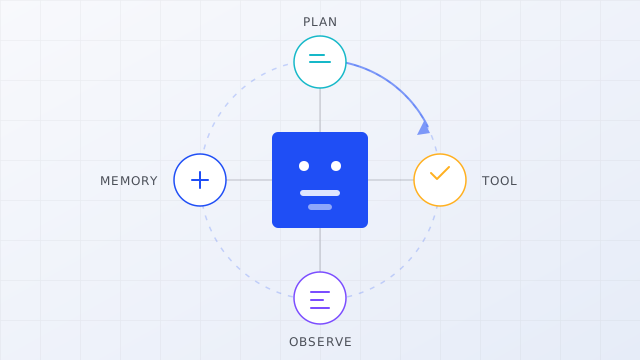
Building an agent is not the same as writing a longer prompt. MiliAgent keeps a plan it can revise while it runs: it splits the task first, then re-plans the remaining steps as execution turns up new information. A failed tool call retries under policy, drops down to a fallback path, or hands the task back to a person. Complex work can be divided across roles — retrieval, calculation, drafting and review each own a segment — with a lead agent consolidating the result.

  • Task decomposition and re-planning Subtasks derived from the goal, with the remaining steps adjusted when the information changes
  • Tool registration and argument validation Tools declare their inputs in JSON Schema; a call that fails validation is never sent
  • Short-term and long-term memory Context is held within a session; preferences, frequent entities and past conclusions carry across sessions
  • Human confirmation steps Writing to a database, sending a message or submitting an approval is held until the named role confirms it
Plan - act - reflect Function calling Multi-agent roles Step and budget ceilings Timeout retry Model fallback

Book a MiliAgent demo

An agent cycling through planning, tool calls, observation and output
MILIFLOW

Workflow orchestration: put AI inside the flowchart, not next to it

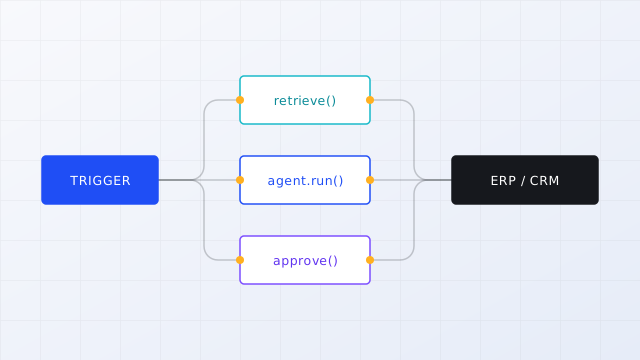
MiliFlow uses a visual canvas to connect agent nodes, human nodes and external systems into a process that actually runs: a new ticket starts it, amount and risk level decide the branch, anything over the threshold goes to a person for approval, and a failure unwinds through compensating actions. Results are written back to the ticketing system, and a confirmation, a follow-up question or a rejection can be handled directly in your enterprise chat tool, with the record synced back to the process instance.

  • Event and scheduled triggers A new ticket, an incoming email or a data change can start a run; batch jobs run on a schedule
  • Conditional branching and approvals Route by amount, risk level or model confidence, and insert multi-level approval where it is required
  • Idempotency and retries Every run carries a unique key, so a repeated trigger never creates a second ticket or a second submission
  • Rollback on failure Actions already written to external systems are reversed by compensating steps, with the whole run recorded
Event triggers Scheduled batches Conditional branches Multi-level approval Idempotency keys Compensating rollback

Talk through how your process would connect
Orchestration canvas: trigger node, conditional branches, an approval node and a rollback path
MILIRAG

Knowledge engine: every answer can be traced back to the source text

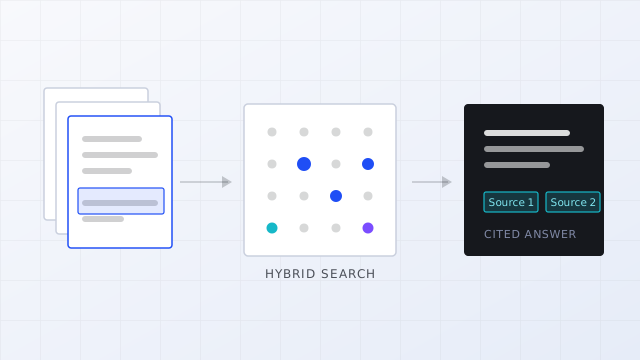
The ceiling on retrieval quality is usually set at the parsing step. MiliRAG first converts two-column PDF layouts, tables that run across pages and scanned files into structured text with the heading hierarchy intact, then chunks on semantics and structure at the same time, so a table or a clause is never cut in half. When a source updates, only the changes sync — there is no full reindex.

  • Complex layout parsing Two-column PDFs, cross-page tables and OCR for scans, with heading levels and cell structure preserved
  • Hybrid retrieval and reranking Vector recall paired with exact keyword matching, then a reranking model to narrow the candidate set
  • Permission pass-through The user's visibility in the source system is resolved first; documents they cannot open never become candidates
  • Citations down to the passage Every piece of evidence links back to a specific page and paragraph of the original file, which makes review quick
Layout parsing OCR for scans Semantic chunking Vector + keyword hybrid Reranking model Incremental sync

Try a parse on your own documents

Knowledge engine flow: document parsing, chunking, hybrid retrieval and an answer carrying citations
MILIGATE

Model gateway: every call to a model leaves through one door

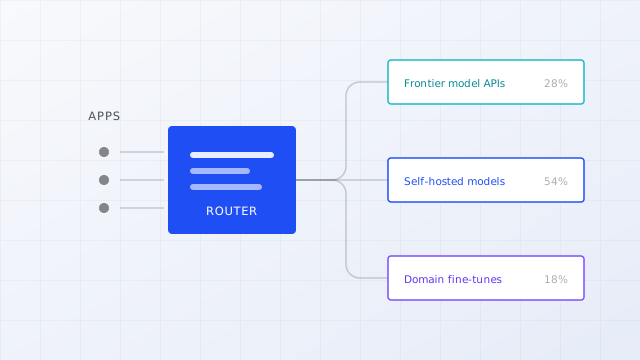
The value of a single exit point shows up the day you swap something out and don't have to edit application code. MiliGate exposes one stable API upward and connects downward to commercial model APIs, self-hosted open models and domain fine-tunes, choosing the route by use case, cost ceiling and latency budget, and failing over automatically when the primary model times out or errors. A new model can take a slice of traffic as a canary release first; if the numbers look wrong, the previous routing config comes straight back.

  • One API Commercial, open and fine-tuned models share the same calling interface, so changing provider leaves application code untouched
  • Policy-based routing Pick the model by use case, cost ceiling and latency budget, and fall back automatically when something goes wrong
  • Rate limits and per-department accounting Quotas by department, application and use case; token and call spend recorded line by line
  • Redaction and audit Sensitive fields are detected and replaced before a request leaves; inputs, outputs and routing decisions are all retained
One API Use-case routing Cost ceilings Rate limits and quotas Outbound redaction Canary and rollback

Review how your current calls would connect

Model gateway: one entry point routing by policy to several model backends, logging every call
MILIEVAL

Evaluation & observability: did this change make it better or worse?

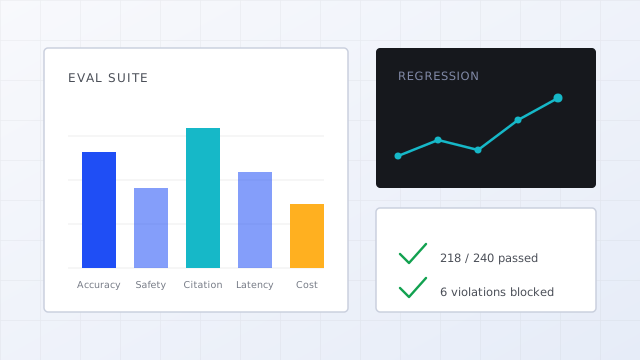
"Seems fine" is not a reason to ship. MiliEval assembles an eval set with reference answers from real tickets, questions and documents, re-runs it on every prompt edit, model swap or added tool, and lists sample by sample what improved and what regressed. After launch it samples live sessions for review and feeds the problems production exposes back into the eval set, so the baseline keeps up with the business.

  • Eval sets from business samples Built from real tickets and questions, covering common phrasings and known edge cases
  • Automatic scoring plus human review Rules and models score first; disagreements go to a reviewer whose answer becomes the reference
  • Version-to-version regression Compare any two versions sample by sample, with regressions listed separately instead of hidden by an average
  • Live tracing and alerts Sampled sessions are reviewed, and an alert fires when hit rate, latency or cost crosses the threshold
Eval set management Rule-based scoring Model-based scoring Human review Regression dashboard Threshold alerts

Set the first acceptance criteria with us

Evaluation dashboard: per-dimension score bars and a regression trend line across versions
Deployment

Three deployment models, picked by where the data may go

What decides this is rarely technical preference; it is how far the data is allowed to travel. The three below divide the data boundary and the operational responsibility very differently. None of them is a reduced feature set.

Managed cloud

For teams that want to prove the value before investing in infrastructure. Data sits in a tenant isolated per customer, in an availability zone inside the jurisdiction you nominate, and knowledge bases and logs are never stored alongside another customer's. Milisoft handles version upgrades, scaling and on-call cover; your team configures the use cases and watches the results.

Private deployment

For financial and manufacturing work where data cannot leave the internal network. Every component installs in your own data centre or private cloud; model weights, the vector store and audit logs all stay inside the boundary, with support for sovereign hardware and software stacks and offline upgrade bundles. Your team runs it day to day, and we supply deployment scripts, inspection checklists, the upgrade manual and remote support.

Hybrid

For organisations where most data is sensitive but a few use cases need a stronger model. Knowledge bases, logs and business systems stay on the internal network, and only the redacted fragments that are genuinely needed leave through MiliGate to reach an external model. Policy states exactly which fields may leave, every outbound call is recorded, and operational responsibility is agreed separately for the internal and outbound halves.

Specifications

The key specifications on one page

These are the points buyers press hardest on during evaluation. The full interface list, performance baselines and deployment checklist are in the technical white paper — ask us and we'll send it over.

CapabilityDetails
Deployment Managed cloud, private deployment or hybrid — pick one. Private deployment runs either on a Kubernetes cluster or as single-host Docker Compose, with an offline installer provided.
Model access MiliGate connects mainstream commercial model APIs, self-hosted open models and domain fine-tunes through one interface, with primary, standby and fallback order configurable per use case.
Identity & permissions SSO, LDAP and OAuth2 single sign-on; roles and data permissions are inherited from the source system, and retrieval results and tool calls are re-checked against the caller's identity.
Audit & traceability Every session, model call, tool action and cited source is recorded. Logs export to your SIEM or data warehouse, and the retention period is set by policy.
Observability Built-in dashboards for call volume, latency, token cost, failure rate and eval scores, plus Prometheus metrics and webhook alerts.
Extensibility Tools, data sources, document parsers and scorers all connect as plugins, over HTTP or through the SDK, with a local debugging environment included.
Deliverables Source for the custom work, container images and deployment scripts, architecture and interface documentation, the eval set, the operations runbook and role-based training material.
Support level Standard, Professional and Flagship. Response times, on-call hours and regression frequency vary by tier — see service tiers & SLAs.

Request the technical white paper and deployment checklist

FAQ

Six questions we get most during evaluation

Can we adopt just one module?

Yes. Each of the five has its own API and its own deployment unit. The most common starting points are MiliRAG, to build the knowledge layer, or MiliGate, to consolidate the model calls already scattered across existing applications. MiliFlow on its own can orchestrate human nodes and external system calls; the agent nodes inside a process need MiliAgent, which is a capability boundary rather than a bundling requirement.

Do we have to replace our existing systems?

No. We sit as a layer above the ERP, CRM, office systems, ticketing and data platforms you already run, connecting through APIs, message queues or read-only database views, without touching their schemas or business logic.

If one system genuinely has no usable interface, we build an adapter for it rather than advise you to replace it.

What is the minimum hardware for private deployment?

It depends on which modules you run and where the model sits. If you run only MiliRAG and MiliGate with inference on an external API, three standard x86 servers are enough to start; running open-model inference inside your network means adding GPU servers sized to your concurrency.

During the solution stage we produce a specific configuration list, with the headroom explained, based on your concurrency, document volume and latency targets — so you don't have to buy for the maximum case up front.

How costly is it to change model provider later?

Application code usually doesn't change by a single line. Calls all go through MiliGate, so switching provider is a routing config change. The real work sits in prompt adaptation and quality verification, and a MiliEval regression run quantifies that — in most cases the switch can be assessed within a few working days.

What happens if quality falls short after launch?

The acceptance criteria go into the eval set when the project starts. If they aren't met, the next stage doesn't begin — that is how we contain the risk, and it is your exit point.

When something does regress, MiliEval first locates whether the cause is a retrieval miss, prompt drift or a model version change; we fix that step, then add the affected samples to the regression set so it doesn't happen twice.

Will our data be used to train models?

No. Under private deployment the data stays entirely inside your environment and we have no channel to it. When an external model API is used, MiliGate redacts before the request leaves, and training on your data is switched off using whatever option the provider offers.

Data use, retention periods and deletion are written into the data processing clauses of the contract; you can also read our privacy policy.

Want to watch this path run once?

Bring one of your real documents and one action you want automated. In a single demo we take parsing, retrieval, execution and the audit trail end to end, and afterwards give you a module recommendation, a deployment model and an effort estimate for the first stage.