We treat AI as engineering work, not as a concept
Milisoft is a software engineering company. We don't train foundation models, and we don't stop at a written recommendation. We take model capability that already exists and connect it to your data, your permissions and your approval chains until the whole path runs — then hand over the source, the eval set and the operations runbook.
A company that writes the code and then keeps it running
Milisoft started in 2023. The team comes from enterprise software delivery, search and recommendation, and data platforms. What we know well is dirty data, ageing systems, permissions that span departments, and the edge cases that only surface after launch.
We produce two things: five platform modules of our own, and custom delivery built on top of them. The first means no project starts from nothing. The second means every platform feature came out of something that actually went wrong on a real project.
Draw where the data goes before writing any code
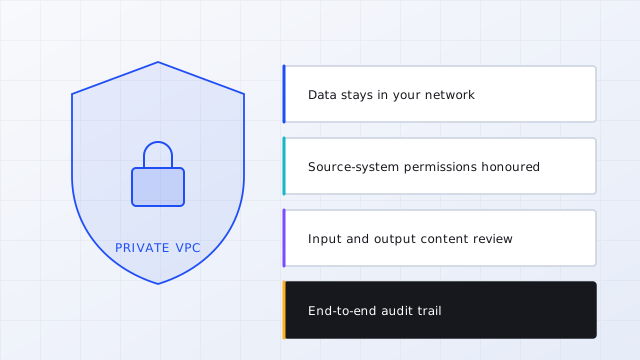
Almost every enterprise asks the same first question: does our data leave? Our default answer is that it doesn't. If it can be deployed privately, it stays on your network; if the source system already knows who may see what, we reuse that instead of building a second set of accounts. What follows is how we engineer, not a certification we hold.
- Data stays in your network Full private deployment and offline operation are supported, with network zoning that can follow China's MLPS requirements
- Permission pass-through We reuse your existing identity system; retrieval and tool calls stay strictly inside what the user can already see
- End-to-end audit trail Every call, every citation and every tool action traces back to a named person and a timestamp
- Least privilege Delivery staff are granted access per project, entry to your environment needs approval, and accounts are revoked when the project closes
Security practices at a glance
| Practice | What we do |
|---|---|
| Data storage | Deployed in your own environment by default, with the vector index kept separate from business databases. We keep no copy of your business data on our side, and sample debugging happens inside your environment. |
| Encryption in transit | External and internal calls both run over TLS with certificate validation. Keys and model credentials sit in your key management system and never go into code or images. |
| Permission model | We connect to your existing SSO / LDAP identity system rather than creating accounts. Retrieval results and tool calls are filtered by what the caller can already see in the source system. |
| Log retention | Prompts, model responses, tool actions and citation sources are all written to storage. You configure the retention period, the redacted fields and the export format, and the logs can feed your existing logging platform. |
| Model calls | Every model call leaves through MiliGate, with available models and quotas set per department. For classified work, calls can be restricted to self-hosted models on your internal network. |
| Third-party dependencies | The dependency list ships with the deliverables, and the build stage scans for licences and known vulnerabilities. Offline installation packages are available so deployment never has to pull from the internet. |
| Staff access | Delivery staff get the minimum grant per project. Access to your environment needs approval from your side and is screen-recorded or logged throughout; accounts are revoked when members rotate off and when the project closes. |
Want to know how we actually work?
The fastest way is to look at the real material. In one meeting we'll open an eval baseline, a code walkthrough checklist and the contents page of an operations runbook, and you can judge for yourself whether this way of working can carry your project.