AI agent development
Agents written around your actual workflow: decompose the task, call the tools, read the knowledge, leave a trace. From a single assistant to multi-agent teams, delivered as engineering assets you can run, regress and hand over.
Milisoft is a software engineering company focused on AI agents. We don't hand over a chat box. We wire the model, your knowledge, your business systems and your approval chain into one path that runs end to end, stays governed, and shows its costs.
Private deployment · Permission pass-through · Full audit trail
TASKDraft this week's operations report for the regional sales director and flag anything a human needs to confirm
Elapsed 8.4sTool calls 6Citations 12Needs review 2
Most enterprises don't get stuck on the model. They get stuck picking the wrong use case, failing to connect the data, or having nobody own the thing after launch. Our work is organised around those three gaps.
Agents written around your actual workflow: decompose the task, call the tools, read the knowledge, leave a trace. From a single assistant to multi-agent teams, delivered as engineering assets you can run, regress and hand over.
Private deployment, fine-tuning, latency and cost tuning — and on-call cover once it is live. Getting a system running is the start; keeping it running is the service.
Use-case discovery, feasibility testing, cost and return modelling, and the process changes that have to happen around the software. Decide what not to build first, then spend the budget where it converges.
MILIAGENT
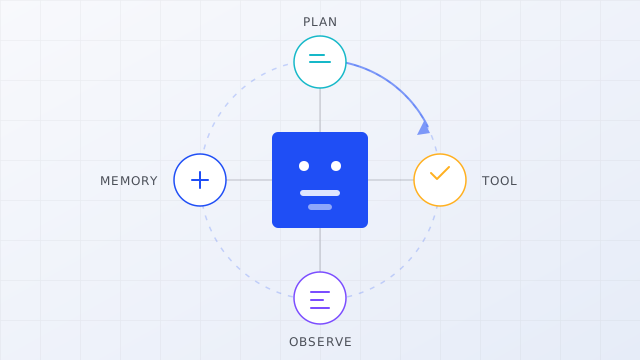
Task decomposition, tool calling, long-horizon memory and multi-agent collaboration. Human-confirmation steps are built in, so high-risk actions never run unattended.
MILIFLOW
Puts agents inside the real process: triggers, branches, approvals, retries, rollbacks. AI becomes a node in the workflow rather than a toy beside it.
MILIRAG
Parsing for awkward document layouts, hybrid retrieval with reranking, and permissions inherited from the source system. Every answer can point back to where it came from.
MILIGATE
One entry point for commercial APIs, self-hosted open models and domain fine-tunes. Route by policy, charge back by team, keep the full audit log.
MILIEVAL
Build eval sets from your own business samples, then re-run them on every prompt change, model swap or new tool. Quality movement becomes visible instead of anecdotal.
Where to start
Bring one real scenario. In 60 minutes we'll draw the data flow, the permission boundary and a first version of the acceptance criteria, and follow up with a written recommendation.
Plenty of AI projects die on "seems fine". In week one we sit down with the business owner and define what correct means: real samples become an eval set, and accuracy, citation hit rate, blocked access attempts, latency and cost per call all end up on the same chart.
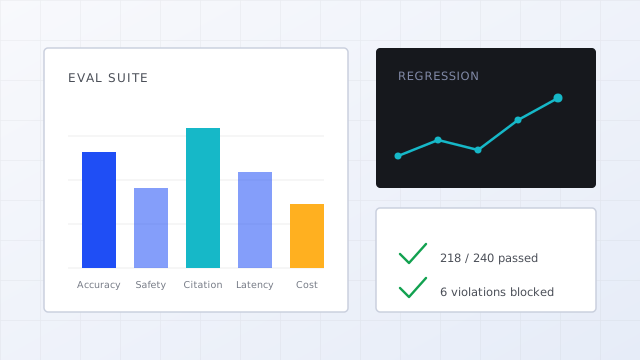
We are a software engineering company, not a black box. At the end of a project you hold the full source, the deployment scripts, the architecture notes, the eval set and the operations runbook. Your team can change it, release it and debug it without us.
Research synthesis, clause-level compliance comparison, agent assist. Traceability, strict permissions and reproducibility are hard constraints here.
Equipment manual Q&A, process parameter lookup, QA report analysis. Decades of drawings and veteran know-how become a searchable knowledge layer.
Product content at volume, shopping and post-sale assistants, campaign assets. What matters is scale, consistency and a compliance backstop.
Engineering productivity, log and data analysis assistants, growth content pipelines. These teams know the tech; they want it to fit their existing toolchain.
This is a real timeline. If a stage doesn't pass, the next one doesn't start — which keeps budget away from assumptions nobody has tested.
01 · 2–3 weeks
Interviews with business and IT, a ranked list of candidate use cases, the current state of data and permissions, and a cost-and-return estimate.
02 · 4–6 weeks
One or two use cases built to a working version, with the eval set built alongside. Acceptance runs on real business samples before any further spend.
03 · 6–10 weeks
Connected to production data and your permission model, then load tested, security reviewed, canary released and wired to monitoring — with source and runbook handed over.
04 · Ongoing
On-call cover to the agreed SLA, scheduled regression and tuning, and proven capability copied into adjacent teams and use cases.
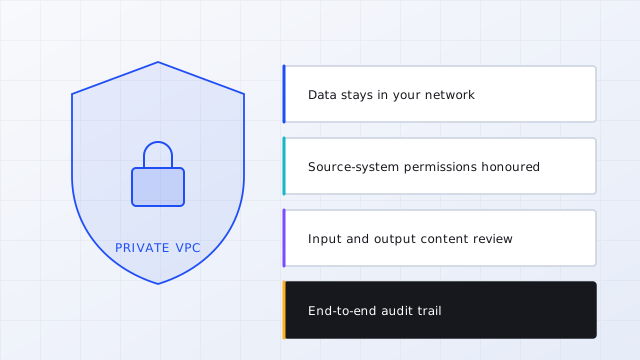
We design to the strictest boundary by default: if it can stay on your network, it does; if the source system already knows who may see what, we reuse that rather than building a second permission model. Security is a constraint in the first architecture diagram, not a chapter added before launch.
No need to prepare a brief. Describe the one thing you most want automated, and one meeting is usually enough for a feasibility call, a rough size, and a clear first step.